Wednesday, 4 March 2020

Flexible travel dates in response to the COVID-19

The coronavirus (COVID-19) first surfaced in December 2019, and began to spread within China in January 2020. By late January 2020, there was more attention being paid to its virulence and contagiousness, with fears that another SARS-like event would happen. Currently, there are over 95,416 confirmed cases and 3,286 deaths according to the tracker by Johns Hopkins.

Understandably, travel to the region has been rattled. Flights to and from China and Hong Kong have been cancelled, and even travel bans and restrictions have been placed by even the most democratic of countries (i.e., the United States).

I had booked a ticket to Taipei ...
In October of last year, I had booked my ticket out to Taipei as I normally do. Taipei is one of my favorites in Asia for various personal reasons. Taiwan has a special status in the world: China strongly believes it is theirs and would consider it a part of China, whereas Taiwan views itself as its own country.

This distinction is important because when all the flights were being cancelled to China (including Hong Kong), Taipei was not considered a part of that ban. Being anxious about the possibility of having to do a quarantine myself, I cancelled my flights. I no-showed at the hotel and forfeited a non-refundable hotel rate. In all, I was out by roughly $600.

I was supposed to go to Taipei again in mid-March. Luckily, I did not book my ticket or accommodations.

People, in general, are hesitant to book. Reports are now that there is an outbreak in Italy, Iran, South Korea, and Japan. It is unknown when and where the next outbreak will be.

United Airlines is cutting routes both domestically and internationally
According to View From the Wing, United Airlines is cutting 10% of its domestic (US/Canada) flights, and 20% of its international routes (cancellations to China have already been included).

Airlines are offering increased flexibility
For the most part, all tickets need to be booked directly with their

1) United Airlines: Flights booked between March 3, 2020 and March 31, 2020 will include free flight changes over the next 12 months. However, it only covers the change fees; passengers are still required to pay the fare differences. Passengers may also choose to cancel flights; the residual value of the ticket can be applied to any new booking up to one year from the original ticket's issue date.

2) Air Canada: "A one-time change fee waiver will apply to tickets purchased between March 4 and March 31, 2020 for travel within 12 months of the issue date on your original ticket, provided changes are made at least 14 days before your departing flight. Kindly note that any fare difference will apply." Tickets must be on a 014 ticket stock and must be purchased from Air Canada.

3) American Airlines: "If you purchased a ticket on American Airlines between March 1, 2020 at 4:30 p.m. CT and March 16, 2020 at 11:59 p.m. CT, you may change your flight once without paying a change fee if the change is made at least 14 days in advance of your outbound travel date. Tickets must be purchased for travel between March 1, 2020 and January 26, 2021." New Travel must be completed within one year of the ticket's original issue date.

4) Delta Airlines: No change fees for all tickets purchased between March 1-31, 2020. "Tickets can be changed one-time to an alternate itinerary." Fare differences will apply. If you wish to cancel, applicable change fees and fare differences will apply.

5) Alaska Airlines: For tickets purchased between February 27, 2020-March 31, 2020, tickets may be cancelled with the funds deposited to the passenger's online "My Account" Wallet. A one-time change may be made with the change fee waived; travel mjust be completed by February 28, 2021.

6) Westjet, Canada's second largest airline, does not offer any change policies.

I think I can actually book that ticket to Asia again in the fall!

Tuesday, 3 March 2020

Promo: Marriott's Elevated Earning

Marriott's first promotion of the year was released today: Elevated Earning. The registration link is live.


Register by May 31, 2020 for stays between March 17, 2020 - June 14, 2020, earn 2,000 points after your second stay. All properties are eligible, and the earning potential is unlimited.

Compared to IHG's most recent 4x the points event, where after the 3rd stay one earns 4x the points, this is a rather weak promotion.

2,000 points, in my estimation, is worth roughly 0.6 cents CAD a piece. So with this promotion, you get the equivalent of $12, regardless if you stay one night or 28 in a row.

Let's hope the next Marriott promo is more generous.

Sunday, 1 March 2020

Air Canada bonus aeroplan points

I've never quite understood why, but the Aeroplan promotions on Air Canada's website are always kind of hidden.

The promotion I stumbled upon today is this one: Travel to the US: Make your miles take off


This promotion began February 25, 2020. Register and book by March 20th, and travel by June 30th to destinations in the USA to receive:

  • 50% bonus miles on two one-way segments to/from the USA and back on Standard fares (i.e., fares earning 50% AQM and Aeroplan points)
  • 100% bonus miles on two one-way segments to/from the USA on Flex or higher fares (i.e., fares earning 100%+ AQM and Aeroplan points)
Interestingly enough, according to the fine print, if you book two people on the same ticket, only the first person listed on the ticket with a valid Aeroplan account will receive the bonus. So if possible, book separately. This may be difficult to do if you're using a customer care voucher as those vouchers will let you save on up to 4 people traveling on the same ticket. I'm not sure bonus Aeroplan points are even worth it if it means foregoing the use of those vouchers. 

Registration is required. You can register at the bottom of this page

Saturday, 15 February 2020

Alaska Airlines To Join the Oneworld Alliance


It was a while ago that I last wrote about Alaska Airlines. I had promoted this as a backup program to for anyone who flew and collected miles on Star Alliance-based programs (I have since flirted with Asiana, United, and now Air Canada). 


I had written a post about the flexibility of Alaska Airlines, and about the benefits of "going at it alone." Back then (~2013), they were partners with numerous Skyteam members (KLM, Air France, Delta, Aeromexico, and Korean Airlines) as well as Oneworld members (American Airlines, Cathay Pacific, Qantas, and British Airways). They had absolutely no Star Alliance members. What a perfect complement for those who don't normally fly on Skyteam or Oneworld member airlines with regularity, but don't actually want to lose out on any miles that could potentially be earned?

Something that was also unique was that all airline partners counted towards status for Alaska Airlines. This, of course, was not a big deal given that the benefits of status were only really for travel on Alaska Airlines, and Alaska Airlines had a minuscule footprint compared to its partners.

Then there were some changes that weren't so good
Delta started to encroach upon Alaska's Seattle hub and began to compete with Alaska. Finally, in 2017, Delta and Alaska severed their relationship: they were no longer code-sharing, and there were no longer reciprocal mileage earning benefits.

In 201, American Airlines had taken steps to do something similar. Reciprocal elite benefits were taken away (waived checked baggage fees, priority boarding, preferred seats). Members could no longer earn miles on domestic flights that were not under a code-share agreement). In October 2019, more changes were announced: Alaska Mileage Plan members could no longer earn or redeem on American Airlines' flights and vice versa except for on code-share flights after March 2020.

And then something big happened 

On February 13, 2020, Alaska announced that it had full intention of joining the Oneworld alliance. This was a complete reversal of the cuts made to its current Oneworld world partner, American Airlines.


Some of the notable pieces of this release are that:

  • Effective immediately, one can redeem points again on all American Airline flights, and use the AAdmirals club from American Airlines
  • Effective in Spring 2020, one can earn points again on all American Airlines flights
  • Effective in Summer 2021, Alaska can earn and redeem on all Oneworld partner airlines, and elite members will have full reciprocal benefits within the Oneworld partner airlines. 

What it doesn't say (but seems obvious to me), is that once Alaska enters into the Oneworld alliance, its relationships with the other "global member airlines" will likely have to cease. This means that it will likely no longer be a good backup for those who are occasional flyers with Skyteam airlines. And of course, people will be comparing why one would want to choose American over Alaska when it comes to crediting points from flights. One will need to understand

  • points earning ratios
  • changes to mileage requirements for earning status
  • changes to minimum spend requirements (currently Alaska does not have any whereas American does)
  • changes to redemption costs 

More details to be released soon, we hope.

Wednesday, 12 February 2020

Things I Love About My Favorite Airline App: United Airlines

Every major airline has an app. And after having used many airline apps (American, Delta, Alaska, Air Canada, Qantas, and more), I have decided that my favorite and most functional app has got to be United Airlines'.


Here is what I wish all apps had:

1) An easy introduction page with all the vital (and bonus) information


Of note, there's access to your membership number (greyed out), one's account balance, one's status tracker (to always show you how close or how far you are from your next status goal), and how many upgrade points you have available, if you choose to use them.

What is unique about United's app is that they include your lifetime miles. If any program's million miler status is actually important to the program itself, it should make one's progress towards that aspirational status clear. I am, apparently, over 700,000 miles away from that goal. 

2) Future flight bookings and the ability to check in by clicking on the booking

I don't have an upcoming flight and so I can't really demonstrate. However, it is easy to access all of my upcoming booked flights. One can view details about the flight and make changes to or cancel the flight. One can check into the flight and store boarding passes for flights.

3) Flight arrival times and departure times are easily found and easily interpreted.   

Flight information is bold and clear. If there is a delay, there's typically a small message above the flight information telling you what is happening or why it is delayed. You can click "where is this aircraft coming from" to help you decide when it is time to go to the gate: obviously if the incoming flight hasn't arrived yet when it is officially boarding time for your flight, there's no point in leaving the lounge to go to the gate. Grab another drink in the lounge. Not every airline has this feature.

4) Accurate, clear information about where you are on the standby list and upgrade list and
5) A seat map that is always up to date and always viewable, even until two days after the flight. 


There is no question about where you are on the standby list and the upgrade list. Unlike other airlines, once the flight is closed, you can still see what the list looked like. You can use this information to let you know how likely the flight is to be full when you're flying this route in the future. If you're into seeing who is non-rev and upgrading, you can figure that out easily (everyone from And, R. and below are are non-rev). Furthermore, the seat map is always active and up to date which is also a nice source of information.

I quite like that once the flight is closed, you can pull up the seat map to see if that empty seat beside you really is free -- you can move your baggage from under the seat in front of you one seat over to increase legroom. Very hand to know.

6) Ability to book flights and check out award seats

Like with virtually every airline app out there, you can book either award seats or revenue seats. If you lived in America, you could purchase and pay for the seats right on the app itself. What I wish was for the ability to pay using other currencies; Canadians aren't allowed to buy tickets because most of us do not have an American address (for the credit card) nor a USD-funded bank account. 

It seems pretty basic, but all of the features make the app very functional to me. If it could allow me to book things in Canadian funds, I think this app would be kind of perfect. Now I just have to wait for the other airlines to catch up ...


Sunday, 9 February 2020

Air Passenger Protection Regulation: My Experience

This post is my add-on to my last post introducing the rules of the Air Passenger Protection Regulations. More specifically, this is about my own experience with this.


Situation #1
I flew on Air Canada to Honolulu on January 9th (AC2411). This was canceled that morning because the aircraft (operated by Omni Air, a lease agreement) was suffering from mechanical issues and canceled on the way coming back from Honolulu. This would be the same plane that would operate YVR-HNL. Air Canada then created a brand new flight, AC2011, which used a larger Air Canada aircraft and crew, and kept the departure and arrival times the same. As there were some weather problems, we arrived roughly two hours late.

In this instance, compensation was not required from the airline because the arrival time of the new flight mirrored the canceled flight. Also, the eventual delay that resulted was due to weather conditions that were outside of Air Canada's control. Finally, the delay was only 2 hours long, and it was less than the 3 hours required before compensation was due.


Situation #2
When flying home on January 14th, AC 2410 (HNL-YVR) was again canceled. This was because the inbound flight (YVR-HNL) was also canceled. This flight, also operated by Omni Air, initially was delayed by what I assume was mechanical issues for an hour or two. This was also in the context of snow, which understandably causes delays.

Omni Air flights are run strangely when working in coordination with Air Canada. Half the flight attendant crew are from Omni Air, the other half are from Air Canada. The Omni Airways flight crew do straight turns as their duty day is longer than Air Canada's flight attendants. The Air Canada flight attendants do a layover in Honolulu.

When the aircraft was delayed enough, I am guessing the Omni Air crew had timed out -- they were no longer able to operate the flight to Honolulu and then back again. Therefore, Air Canada had canceled the YVR-HNL flight and had sent out a text stating that the reason for the cancelation was "crew constraints." Because YVR-HNL was canceled, HNL-YVR was also canceled, also because of "crew constraints."

At the airport, we managed to be re-directed on a United flight from HNL-LAX, and then onwards to YVR. Our original itinerary was supposed to have us arrive at 705am, and this new itinerary was scheduled to have us arrive at 327pm. This represented an 8 hour delay. Arguing that Air Canada did not need to have crew constraints because they were departing from a YVR crew base (with standby and reserve flight attendants who could replace the timed-out crew), this was a flight cancellation that was within Air Canada's control. I was expecting a $700 in compensation.

Air Canada Responds
"We are in receipt of your claim under the Air Passenger Protection Regulations. We are sorry for the delay you experienced at arrival to your final destination. 
In this instance, the compensation you are requesting does not apply because the delay was caused by a safety-related risk. 
Compensation only applies to customers who arrive at their destination 3 hours or more for situations within our control. Compensation does not apply when there are unforeseen safety-related issues such as mechanical problems outside of scheduled maintenance or mechanical problems that had not been identified during scheduled maintenance. 
The delayed impact of a flight may be from a previous scheduled flight.  The airplane, flight attendants or pilots may be delayed on a multi-leg journey and these factors can be contributed to the subsequent onward impacted flight according to the regulations."

The End Result
In the end, they denied my claim but were willing to provide a $200 e-voucher for future travel. I will admit that I am unsatisfied by their rationale. The aircraft was presumably fixed at some point, otherwise they would have cited "mechanical issues" in our text alerts. It was very plainly specified as crew constraints. While crew fatigue could also be safety-related, to not use "fresh" crew from their standby reserve is clearly something within the airline's control.

I figure that I was written off here.

What has your experience been in trying to claim compensation? Apparently, I am not the only one to have issues

Saturday, 8 February 2020

Air Passenger Protection Regulations: An Introduction


On December 15, 2019, Canada finalized its revised Air Passenger Protection Regulations. There are many parts to this, including rules about communication, delayed and cancelled flights, denial of boarding (overbooking), tarmac delays, seating arrangements for families, and lost/damaged baggage. These rules are only for flights that land or depart in Canada.

What is probably the most significant to me are the new rules surrounding denied boarding (overbooking) and delays/canceled flights.

What happens when you're denied booking?
When flights are overbooked, airlines will first solicit volunteers to give up their seats. If passengers volunteer to give up their seats, this is considered a voluntary denial of boarding. There is no prescribed amount that is required for a voluntary denial of boarding (VDB): if you feel like you didn't get enough compensation, then don't volunteer your seat. If airlines cannot solicit enough volunteers, they can remove people off of flights without their consent; this is considered an involuntary denial of boarding (IDB). In either case, airlines are expected to get you to the final destination.

For instances of IDB, the overall length of delay to your final destination determines your compensation. If you were supposed to arrive at 9am, and after involuntarily giving up your seat and being rebooked on a flight that will land at 4pm, your overall length of delay is considered to be 7 hours. The rules therefore are as such:

What happens when your flight is delayed?
When flights are delayed, you are still entitled compensation based on the length of time your arrival at the final destination is delayed by. There is a difference between large and small airlines, but given that I typically use "large" airlines, I will only focus on these amounts.


Caveats
The biggest caveat is that no compensation is awarded for situations which are outside of the airline's control. Weather is one example. Compensation is also not awarded for situations that are related to safety (e.g., mechanical problems with the plane). This is a big catch-all, as ultimately, everything and anything can be funnelled into the category of safety.

How to claim
In order to claim compensation, you are first expected to contact airlines directly. They have to respond within 30 days with payment or a reason why your claim does not meet criteria. They are expected to offer either cash as outlined above, or other forms of credit with a higher value than cash. The passenger is always allowed to choose which option they would like.

Have you ever had to use this?
Stay tuned for my own experience of trying to claim compensation ...

Thursday, 6 February 2020

Air Canada for Business: Corporate Rewards

One of the reasons why I had considered Air Canada was their Corporate Rewards program. Their website is here.


What is Corporate Rewards?
Air Canada, like many other airlines (including United Airlines' Perks Plus), has a program designed for small and medium-sized businesses. The idea is that they could help provide a booking platform and small rewards in order to entice small business owners to book with Air Canada and its codeshare partners (for whom they would undoubtedly get a small cut with). This is different than large corporate contracts which likely provide larger discounts and benefits for large, major corporations.

Relevant to me, but maybe not to everyone ...
Being an incorporated physician, I had to register for a small business number. As such, I was now able to apply for this program. You need to have a GST registration number in order to apply. In reality, I'm not sure why more people don't apply for it if they don't have a small side business on the side, as the program is free to join and you could only stand to receive its benefits.

In Canada, the small business number is a 9 digit number. Within that number, there are sub-accounts. If your small business number is 123456789, then the sub-accounts would be as follows:
  • Corporate Tax: 123456789 RC 0001
  • Payroll Tax: 123456789 RP 0001
  • GST Account: 123456789 RT 0001
In theory, you can have several subsections to your business which require several different types of GST accounts, which would lead to RT 0002, RT 0003, RT 0004, etc.

Air Canada requires an RT XXXX. If you do not know or do not need to collect GST, you can use your business number with RT 0001.

What are the benefits of the program?
Given that I am using this for myself and my one other employee, which coincidentally happens to be the person who I travel the most with, I am not really interested in the tracking of corporate spending. It is helpful in the quick-save of the information for the employees, which is somewhat helpful.

More substantively, upon registering, you receive:
  • one Maple Leaf Lounge access (one-time use, not very exciting)
  • five Air Canada Bistro vouchers (good for a meal and snack, or a beverage and snack)
  • 5% discount off of a Maple Leaf Lounge membership (not very helpful)


Most helpfully, there are various levels for spending. After reaching each tier, different benefits are available. Spending is defined as all base fare and certain carrier-imposed surcharges. Taxes do not count. 
  • Level 1: $10,000-$150,000 (CAD) in spending (this is likely where I will be hitting)
    • Up to 3% off base fares on AC flights and partner flights
    • Up to $10 discounts on On My Way flights
    • 10 e-upgrade credits
    • 3 complimentary preferred seat selections, 10% off of other preferred seat selections
    • 1 complimentary Maple Leaf Lounge membership, 5% discounts on other Maple Leaf Lounge memberships, and up to $8 off paid Maple Leaf Lounge one-time access vouchers


  • Level 2: $150,000-$300,000 (CAD) in spending (this is for more serious small businesses)
    • Up to 5% off base fares on AC flights and partner flights
    • Up to $10 discounts on On My Way flights
    • 20 e-upgrade credits
    • 5 complimentary preferred seat selections, 10% off of other preferred seat selections
    • 2 complimentary Maple Leaf Lounge membership, 8% discounts on other Maple Leaf Lounge memberships, and up to $8 off paid Maple Leaf Lounge one-time access vouchers
  • Level 3: $300,000 (CAD) + in spending
    • Up to 6% off base fares on AC flights and partner flights
    • Up to $10 discounts on On My Way flights
    • 30 e-upgrade credits
    • 7 complimentary preferred seat selections, 10% off of other preferred seat selections
    • 3 complimentary Maple Leaf Lounge membership, 8% discounts on other Maple Leaf Lounge memberships, and up to $8 off paid Maple Leaf Lounge one-time access vouchers
The savings will be worth it, I think
I will likely be a Level 1 kinda guy/company. If both my travel companion and I are both likely to reach Altitude 50k, a status that requires $6,000 CAD in spending each, we will automatically reach Level 1. If we were to save the 3% off base fares on AC, that would be a savings of ($12,000 x 3%=) $360 a year. It's not insignificant: this is a round-trip flight from YVR-YYC. 

If you were a "real" small business that regularly flies their employees out of town, and if you were able to reach $150,000 in spending, that would be a savings of $7,500 a year. 

Additional promotions and information
  • Currently, until March 31, 2020 for travel by March 31, 2020, you get a 50% bonus on your spending. That is, if your base fare was $1,000, you would get credited $1,500 for the next tier
  • Other employees do not need to be Aeroplan members. They can be booked using this tool, their spend can be added to the small business' spend, and that employee can still collect on their other frequent flyer program (e.g., United, Asiana, Lufthansa, etc.) 
What do you think of the Air Canada for Small Business program?

Wednesday, 5 February 2020

A Comparison Between United and Air Canada's Mid-Tier Programs

As mentioned in yesterday's post, I am looking to switch from United's Mileage Plus to Air Canada's Aeroplan. This involves switching from United as my preferred carrier to Air Canada.

Source: http://www.aircanada.ca

What's needed for Star Alliance Gold with Air Canada?
The Star Alliance Gold benefits begin really at the Altitude 50k level. In order to achieve this level, one needs to:

  • Fly 50,000 miles, or
  • Fly 50 segments; and
  • Spend $6,000 CAD pre-tax
There's a nice chart that Air Canada has posted which simplifies things. There is no guarantee that this chart will be here next year; like United, they may opt for different status earning criteria next year. 


As you can see, achieving the equivalent of United Premier 1K requires a yearly spend of $20,000. Because no one else pays for my travel, this is absolutely not an option for me. So the toss up is either the 50k or the 75k levels.

What are the benefits?
For Altitude 50k and above, one will always enjoy the Star Alliance Gold benefits. These include things like priority check-in, extra luggage allowance, lounge access, priority boarding, and priority waitlist in case of flight changes or irregular operations. 

Benefits similar to United Premier Gold:
  • Basic Star Alliance Gold benefits
  • Preferred seats on AC with flex fares within North America (United has a more generous policy of economy plus seats on any fare on any flight)
    • United's benefit is irrelevant if I have to fly mostly Air Canada in order to secure Premier Gold/Platinum status
  • Opportunities to upgrade on the program's carrier within North America without any additional fee. Air Canada offers upgrade points which you would have to burn but will generally give you a higher probability of an upgrade. Near the end of my tenure with United, even as a Premier 1K member, complimentary upgrades were very, very difficult to score
Where United wins:
  • Same day change on United flights. This is irrelevant if most of my flights are on Air Canada in order to achieve status
  • Reward bookings do not incur fuel surcharges, but are generally more "expensive" in terms of points. This is likely the biggest strength of United's program. 
  • United offers upgrade points that can be used on generally higher fares for international travel. Air Canada also makes you buy the higher fare in order to be eligible, and if you are successful with your upgrade, you'd have to pay anywhere from $500-$750 each way depending on which ocean you cross. In this sense, international upgrades are not really realistic 
Where Air Canada wins:
  • Higher chance of an upgrade if you encounter an irregular operations, or if they need someone to upgrade for operational reasons
  • Air Canada's Altitude 50k status allows you lounge entry everywhere; United's Premier Gold status only allows you into domestic lounges in the USA only if you're flying an international segment as well
    • This is less relevant as our tickets will always somehow indicate a final destination in Canada, so I have always been allowed in the lounge. 
  • While United does not charge fuel surcharges, rewards are generally cheaper in terms of the number of points needed to be redeemed with Air Canada. Furthermore, more points can be earned with medium to long haul flights compared to United. 
  • Air Canada has more promotions to earn bonus miles than United does in general
  • If one believes that Aeroplan miles are worth it, there are credit cards in Canada that can earn Aeroplan miles.
  • If I'm flying mostly on Air Canada, it would be nice to have these points applied to their lifetime status program. 
So those are the ground rules ...
What's my plan to reach 50k and $6,000 in spending? That's for tomorrow ...


Tuesday, 4 February 2020

Why I need to switch from United Airlines to Air Canada

An introduction:
United Airlines had a special loophole that I had exploited as a Canadian. Previously, in order to reach their top tier status, you required
  • 100,000 miles or
  • 120 premier qualifying segments; and
  • $15,000 USD spend on 016-ticket stock; and
  • 4 segments on United aircraft
In brief, top tier status, 1K, was afforded the following benefits:
  • Star Alliance gold status
  • Increased availability of award seats (no fuel surcharges added, unlike Air Canada's Aeroplan)
  • Free changes and cancellations for award reservations
  • Free same-day changes
  • Unlimited complimentary upgrades on domestic itineraries (space available)
  • Opportunities to upgrade internationally (typically 6 segments a year)
  • One free alcoholic beverage and food item on all United flight segments
  • Pre-boarding (before group 1), use of Polaris check in desks on all itineraries
As a self-funded traveler who spent $4,600 USD on United last year, I would not have normally qualified for 1K status. However, non-US residents with a non-US addresses, were exempt from the $15,000 USD minimum spend. This made it easy to qualify for UA Premier 1K status, and I took advantage of this for the last 4 years.

Then the changes happened:
Announced late last year for the program this upcoming year, United changed the policy to be more about dollars spent than distance traveled. Now, their requirements are as such:


One Premier Qualifying Point (PQP) is equivalent to $1 USD spent pre-tax. For the same status, I would need to spend either $24,000 or $18,000 (along with 56 flight segments). 

That is impossible.

But we can game the system still somewhat ...
One way to possibly game the system was to fly on premium cabins on Star Alliance partners. PQP for preferred Star Alliance partners would be calculated as the total number of award miles earned divided by 5. (PQP for the rest of the Star Alliance partners would be calculated as the total number of award miles earned divided by 6).

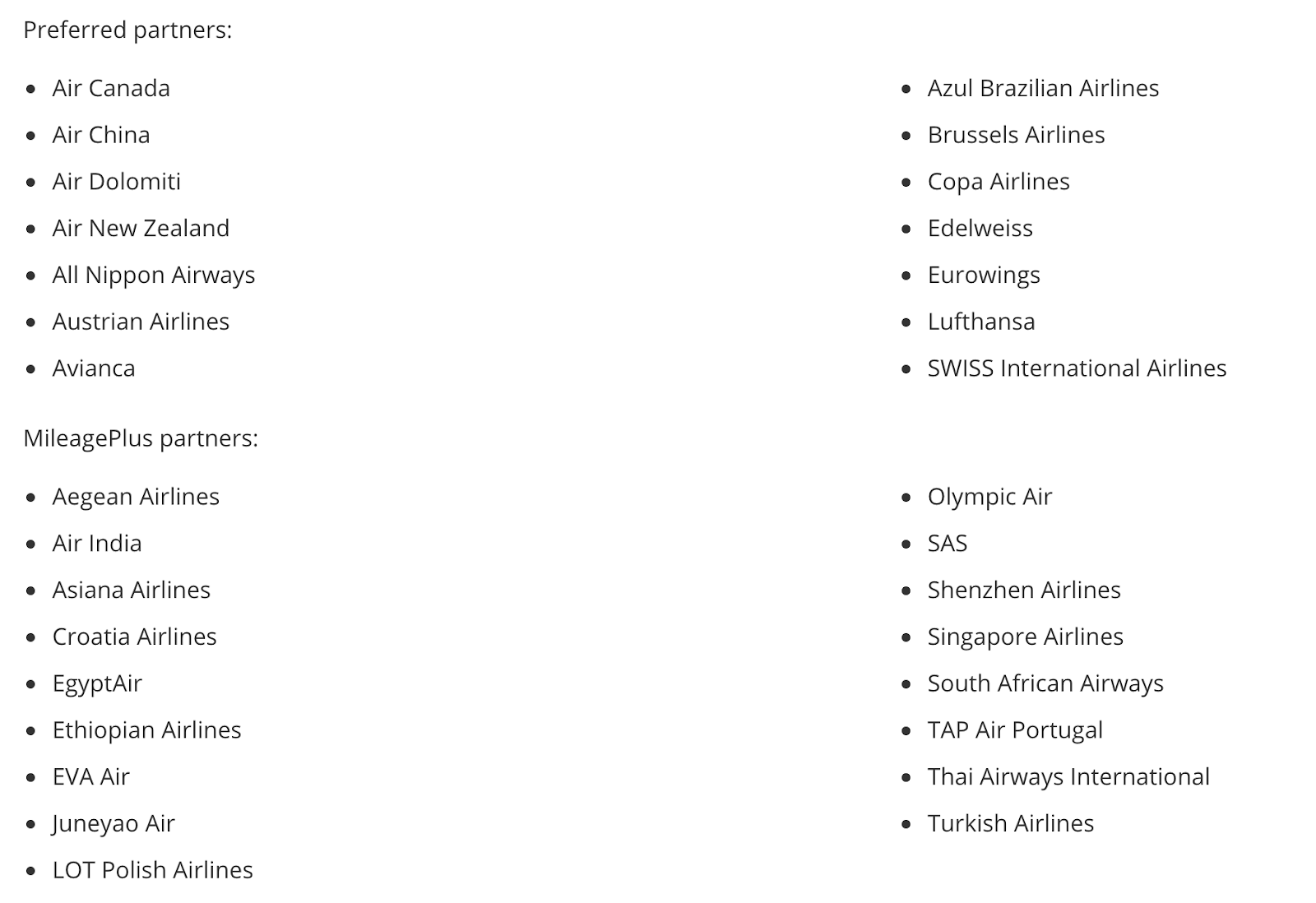
The preferred carriers are:

Air Canada is a preferred partner. 


An example of gaming this system:
A premium economy fare (N-fare) from Vancouver to Taipei (YVR-TPE) would net (5971 x 1.25) = 7,464 miles one-way, or 14,928 miles round-trip. This would net 2,986 PQP for roughly $1,600 CAD fare. 

Or if you bought a business class fare (Z-fare) from YVR-TPE, you would get (5971 x 2) = 11,942 miles, or 23,884 miles round-trip. This would net 4,776 PQP for a roughly $3,500 CAD fare.

Two business class fares from YVR-TPE would cost $7,000 USD, but would give nearly 9,500 PQP, or almost Star Alliance Gold. As you remember, 9,500 PQP = $9,500 USD before taxes. 

And so I thought that it would be cheaper and easier to obtain at least Star Alliance Gold with United Airlines, until I realized that I was going to fly mostly partner airlines. You don't get the best benefits on partner airlines. 

This leads me to the newest part of the journey: if I am going to fly mainly Air Canada to obtain status on another airline, let's work on switching to that airline.

So now, follow along as I play with Air Canada's Aeroplan program ...


Wednesday, 26 December 2018

Boxing Day sales for travel

Some Boxing Day/Week sales in Canada to keep track of:

  1. Air Canada: 15% off all flights, booked before December 28th for travel until June 28. Some notable blackout dates (think every weekend in March, and the February long weekend, as well late April - early May for Asia/Australia). Also valid on numerous code shares including Swiss, Asiana, Lufthansa, Brussels, and EuroWings.
  2. Westjet: interesting promo that I totally missed out on earlier. Set number of discounts available that ran out throughout the day. They initially had 50% off basic and econo fares, then 30% off basic and econo fares. What they have leftover are now the 15% basic, economy, econoflex, and premium fares (ie., are there any other fares to really book on)? More blackouts than Air Canada's (think Valentine's Day, Easter, and the May long weekends)
  3. Flight Centre: 100$ bonus gift card for any roundtrip fare valued at over $1000. Or book any vacation package on certain places valued at greater than $1000.
    • Interestingly with Flight Centre, I'm so used to having the gift card promotion where you'd get $10 bonus for every $100 purchased up to a max of $50 bonus for $500 purchased. This was offered during Black Friday but not on boxing day
I'm sure there are many, many more to be had, but this is a quick reminder to compare what the deals are for next year.

Saturday, 22 December 2018

the looming MBNA devaluation, and introducing its replacement

I used to love my MBNA World Elite Mastercard and I would link to it all the time. This was a fantastic card because it would give you a 2% cash back rebate across the board. You wouldn't have to wait until you were booking travel, you could simply just ask for cash back in the form of a statement credit or even a check. How great was that?! I even had the grandfathered version, where the annual fee was permanently waived.
Back in September 2018, I received a letter from them telling me about a important devaluation for this card. From what I've gathered, this is only for the grandfathered $0 annual fee World Elite Mastercards.
  • points earning would go down from 2 points per dollar to 1 point per dollar (except for a few handful of categories where it would stay at 2 points per dollar up to the first $5,000 in spending a year). earnings would decrease by 50%
  • points redeeming would remain the same if spent on travel purchases. If not, they could be redeemed at a rate of 200 points = 1 dollar. this is a devaluation of up to 50%. 
  • taken together, this card has gone from getting a 2% return on all purchases, to a 0.5%-1% return on most purchases
This isn't going to work for me.

Their equivalent is a $120 a year MBNA rewards world elite mastercard. If you sign up through great canadian rebates, you'll receive a $60 rebate. 
MBNA Rewards World Elite Mastercard
Their new card (which isn't actually new, and is going through its own devaluation) still isn't quite as good as the old one.
  • first, an annual fee is still present. In fact, it becomes $120 a year
  • point earnings are still 2 points per dollar spent
  • redemptions remain 2% return if used for travel, but 1.66% return if used for cash back.
I'm currently using the TD First Class Visa for its 1.5% return on general expenses (if redeemed for travel purchases) and 4.5% return on travel purchases (if redeemed for travel purchases). Its 120$ annual fee is waived because I have the TD all inclusive banking account.
TD First Class Travel Visa
So the difference between the MBNA Rewards World Elite Mastercard and the TD First Class visa is:
  • $120 annual fee 
  • 0.5% higher rate of return with MBNA
  • one requires a $24,000 spend in order to break even.
Do I just make the switch and pay yet another annual fee? Time to think about this some more ...

Saturday, 21 October 2017

New: Cobalt American Express

For the longest time, I've been using the Scotia Bank American Express Gold. Briefly, it has a 99$ annual fee, comes with premium insurance for tickets purchased with the card, and gives you a 4% return on gas, grocery, dining, and entertainment expenses. You have to redeem your 4% rewards in the way of travel in order to get the highest rate of return. Gas, grocery, dining, and entertainment cover a lot of purchases.

The downside to this card is that a) it is an AMEX (which is not as well accepted as other places), and b) non bonused spend receives a 1% return. If you buy your travel on this card, you will get great travel insurance, but you will get a poor rate of return.

Introducing the American Express Cobalt Card


I was recently looking at the American Express Cobalt Card. It's a new card that was recently introduced. You earn Membership Rewards points for the following:
  • 5 points per dollar spent on dining and grocery store purchases
  • 2 points per dollar on gas station, travel purchases, and commuter / transit purchases (no other credit card offers 2% return on travel with all the insurance premiums).
  • 1 point per dollar on everything else
Again, not everyone accepts AMEX, which continues to be a major limitation. Its annual fee is slightly higher than the gold card at 120$ a month, payable in 10% installments.

What does one do with Membership Rewards (MR) points?
  • Convert them at a 1:1 ratio with Air Canada's Aeroplan or Hilton HHonor's programs
  • Convert them at a 1 : 0.75 ratio with Delta, British Airways, Etihad, Cathay Pacific, and Alitalia's frequent flyer points
  • Convert them at a 1 : 0.5 ratio for Starwood Preferred Guest  
  • Convert them to gift cards at a 0.83% return (3000 MR points for a 25$ gift card -- a poor value)
  • Buy toasters at an even worse value
I have recently fallen out of favour of hoarding airline miles because of the difficulty in finding availability for fixed date travel (my work is not very flexible in what days I can leave). So one of the more interesting finds was their own reward chart.
  • 15,000 points (max ticket value = 300$) for a select list of popular routes
  • 20,000 points (max ticket value = 300$) for a travel to same or adjacent provinces/states
  • 40,000 points (max ticket value = 700$) for North American travel
  • 60,000 points (max ticket value = 900$) for European travel
  • 100,000 points (max ticket value = 1,700$) for Asia/Pacific/Australia travel
  • Or 1% back rebated to any other charged travel
If prices are above the max ticket value before tax, then you pay that in addition to the taxes.

This is potentially quite lucrative because it can be up to a 2c/point return on the popular YVR-YYC route (tickets are almost always above 300$ before taxes during times like Christmas). And if you earned 5 points per dollar spent at a restaurant, then that's potentially a 10% return.

The points earned on these airplane tickets themselves earn points, and they are not subjected to capacity controls.

I'm thinking about making the switch ...

Sunday, 31 May 2015

Free 1,000 American AAdvantage miles

Taken from Flyertalk.

Earn 150 points for watching 6 videos and answering a multiple choice question at the end of each. You don't even have to answer correctly. Each video is 1-2 minutes long. After completing all 6, you get a bonus 100 points. You can also enter for their grand prize for a trip for 2 in first class anywhere American Airlines flies.

Though it is technically for US residents, I just did the videos anyway because 1,000 free miles is not insignificant.

Click here for the site.

Wednesday, 20 May 2015

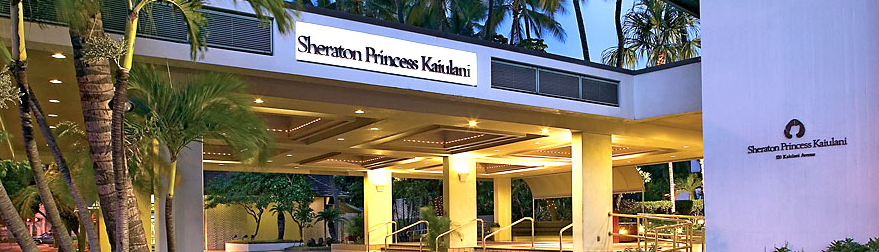
Sheraton Princess Kaiulani's resort fees aren't all that bad


I've decided to stay at the Sheraton Princess Kaiulani in Honolulu this year. Normally, I stay at the independent Waikiki Sand Villa Hotel. However, ever since Expedia foiled my best rate guarantee trick to get hotels for $50 a night, I opted to stay at my regular chain.

This is clearly an older property. The last time I stayed here in November 2014, it was actually slated to be closed down for good. It appears that this plan was delayed month after month to the point where I was still able to book my six night stay with them for my latest stay.

While it's older, it is definitely more than adequate. As a platinum member, I was upgraded to a "suite" (larger room, not a true suite).

One of the things that made me question whether this was a good deal or not was the fact that there were mandatory resort fees of $26.18 per night. On the website, it states that the resort fee includes:
  • Free High Speed Internet Access in guest rooms and lobby (this is included if you've booked on an SPG website anyway)
  • Self-parking for one vehicle (only valuable if you rent a vehicle)
  • Unlimited local and 1-800 telephone calls, up to 60 minutes of long distance telephone calls per day (possibly useful)
  • Two bottles of water in room per day
  • Children 5 and under eat free from children’s menu in designated dining outlets with paying adult (if you have children)
  • Big Kahuna Beach Service (use of sand chair and fresh towels)
  • Whole fruit and water service provided twice daily between 10am and 2pm (when seated in designated area on Waikiki Beach),
  • One free portrait session and a 4" x 8” keepsake by a professional photographer
  • Collections of Waikiki savings booklet
This is clearly not of value to me given that I would already have internet access, am childless, and don't have a car.

However, upon check in, I was pleased to get the "platinum resort benefits." They had separate cards for gold members and platinum members. Among the goodies that I actually cared about were:
  • 250 bonus points per day (value: $5)
  • Free full breakfast buffet for two every morning (roughly $25 with the gratuity included is what I would pay for a breakfast for two anywhere else in Waikiki). There's the option of trading two coupons for one seafood dinner buffet. 
This is in addition to the free use of the beach towels and chairs. Therefore, provided that one is a platinum member, the resort fee breaks even.

Sunday, 10 May 2015

staying at a hotel for call? part work, part mattress-running

since i joined the call group for the hospital that i'm working at since october 2014 (located a good 40 minutes' drive from where i live), i have been staying at the hotel that was located right across the street. since i'm aiming for starwood status, i stay at the local starwood hotel.

this is the rationale and its accompanying "by the numbers".

1) tax implications: is this a reasonable business expense?
as an incorporated physician, there are rules based on the canadian revenue agency as to what is a deductible corporate tax expense. they have stated that if there is an expectation for your job to be present at the job site within a reasonable amount of time, and if staying at a hotel will help you to make more income for your company, then it can be written off as a business expense. the expense itself is taken right off the top. therefore, you're paying for this hotel night using pre-tax dollars as opposed to after corporate tax dollars or after personal tax dollars.

this works in my situation because i don't get a hospital call room, and driving in to the hospital would take roughly 30-40 minutes (which would be bad for patient care).

2) tax implications: how much does it actually cost?
assuming a marginal personal tax rate of 40%, that means that the total cost of the hotel stay is only 60% of the actual cost buying it using pre-tax dollars. for illustrative purposes: if the hotel night cost $100 a night all in, had i chosen to just drive in to the hospital instead and paid myself $100 from the company, i would actually only see $60 in my pocket after personal taxes.

3) which rates to use? 
i have learned that hotels have very loose rules for what constitutes a government employee. having a hospital ID badge which is run by the provincial health authority counts as being an employee of the government. and in all fairness, i am working for the government while i use this rate. this means that the rate falls to $155 a night all in. as per above, the actual cost then is $93 a night. this is the actual amount of money after taxes that i would have actually missed out on in my pocket had i just stayed at home.

4) credit card re-imbursements
you can book using a personal credit card and have the company reimburse you for it. i use the mbna 2% cash back card (no fee version). (note, i argue that i am redeeming for travel credit, which isn't exactly cash back). so by paying $155 a night on my credit card, i get $3.10 back. this is not taxable income as per the canadian revenue agency. so the actual cost per night is roughly $90.

unfortunately, government rates do not qualify for things like ebates or greatcanadianrebates.

5) base points for the rate
the actual base rate is roughly $129 a night. you only get base points based on the rate excluding taxes. i get 2 points per dollar spent, and a bonus point for being an elite member (gold and platinum members both earn 1 bonus point). therefore, per night, i get 387 points.

6) platinum amenity and declining housekeeping
at sheraton and westin hotels, you can choose to get 500 platinum amenity points. you also get 500 points for every night you decline housekeeping. so for each night, you will earn 500 bonus points in some form.

7) bonus point promotions
previous bonuses included double points or 1,000 points for every 5th night etc. the upcoming SPG second trimester promotion is 1,000 bonus points for every 2+ night stay that include a friday, saturday, or sunday. i will conservatively place this benefit as 113 bonus points a night.

8) overall number of points
overall, i expect a total of 1,000 points per night. there are numerous ways to use this in my calculations:
  • convert to aeroplan (1,000 points = 1,250 aeroplan points). i value each point as being worth roughly 1 cent in economy ($12.50) or 5 cents in business ($62.50) if you can actually get seats
  • redeeming for hotels usually nets at least 2.5 cents per point ($25.00). sometimes, if you redeem for low tier hotels, you can get better values. currently, the vancouver sheraton airport is a category 2 hotel. weekends are just 3,000 points. the regular rate is about $150, which is a value of 5 cents per point ($50.00).
9) benefits of staying in a hotel
one has to keep in mind that platinum members get free access to club lounges and club floors at all sheraton hotels. some of these benefits for staying at a hotel include:

  • free breakfast in the lounge ($5 value per day)
  • free appetizers and dinner in the lounge ($7.50 per day)
  • free drinks that i stock my office with later ($2.50 per day)
  • free access to fitness facility / pool
  • no need to clean, laundry/bedsheets are done, utility usage is down
  • actual ability to see patients on call in a timely manner.
  • no need to pay for parking/gas while coming in for call ($6 per day)
  • you can sleep in before coming in to work the next morning (priceless)
10) jump starting my count to platinum status earlier
i used to earn platinum status via stays. previously, i would stay at two different hotels in the same city in order to maximize stay credits. this is no longer the case as i am on call roughly 35 nights a year.

and this is how starwood status will be easy to obtain in 2015 for $21.50 - $59.00 a day.

Saturday, 9 May 2015

a change in star gold strategy -- asiana cuts points on united metal

i used to really like asiana's mileage club scheme because it was an easy way to access star gold status. you would need just 20,000 miles in two years in order to achieve asiana gold (star silver) status, and 40,000 miles in two years in order to achieve asiana diamond (star gold). This served me well: i have had 4 years of star gold status because of them, and have a membership card that's valid until the end of 2016 left to go. star gold status is really quite valuable.

a few years ago, air canada's flex fares (previously named "tango plus") were mostly cut down to 50% elite qualifying miles (EQM) even when they earned 100% in air canada's own program. their tango fares still earned nothing domestically.


(note that not the minimum mileage for international routes is not actually 250 miles as they will later state. i had a tango fare flight YVR-PDX that only earned 125 miles. they cited 500 x 25% = 125 miles and would not budge.)


therefore, around 2012, the vast majority of my transborder and international flights went to united, because all fares would earn 100%. that was until i saw their sudden change on march 1, 2015. now, most of their discount economy flights will only earn 50-75% elite qualifying miles.


therefore, for someone with travel patterns like myself (based in north america, the majority of my travel being based in north america), i would need to fly 40,000 actual miles a year on united or flex-fare air canada (40,000 physical miles x 50% = 20,000 elite qualifying miles per year x 2 year requalification period = 40,000 elite qualifying miles). if i flew just 10,000 more miles a year, i would get premier gold status.

the rule for elite status is to try to earn the highest level of elite status that you can. the next rule is to try to earn that status on the airline that you will fly on the most as they will generally give the most benefits.

so where do i go from here?
for this year, i have opted to credit my points to united. united offers me the benefit of:
  • 100% status miles on united flights
  • 100% status miles on all flex fares on air canada
  • 25% status mile on all domestic tango fares (and 100% on international/transborder tango fares)
  • 100% status miles on almost all ANA flights who i will be traveling on when i go to asia later this summer (they offer 25% redeemable miles on my K-fare, although this is no better than any other program).
  • complimentary economy plus seating
let's see if we can make it to 50k this year.


Saturday, 25 October 2014

air canada makes another change to its elite program

received in my inbox on thursday was air canada's latest changes to its program. in general, most aren't good changes. the official link is here and the permanent flyertalk thread is here.  we knew these wouldn't be good by how their spokesman started off the official thread on flyertalk:


so here are the changes:

1) increase in the number of minimum flight segments/miles required for air canada altitude status (neutral)
  • prestige 25k: 12,500 AQM or 12 AQS
  • elite 35k: 17,500 AQM or 17 AQS
  • elite 50k: 25,000 AQM or 25 AQS
  • elite 75k: 37,500 AQM or 37 AQS
  • super elite 100k: 50,000 AQM or 47 AQS
this does not change the total number of miles or segments that are required to achieve status, just the minimum number of segments or miles flown on air canada metal. this makes sense from their part -- they want to reward increased spending and travel on their airline as opposed to their alliance members'.

compared to united and delta, which requires a minimum spend amount per year on their metal (usually to the tune of ten cents per qualifying mile required on their tickets or their metal), this is probably more generous.

2) 500 mile minimum removed (negative)
for travel beginning march 2015, the minimum mileage amount will no longer be 500 for flex and higher fares, 250 for international tango fares, and 125 for domestic tango fares.


but they justify the additional cost between tango and flex fares by the non-mile benefits that flex fares offer. but one has to wonder about this. a tango fare between YVR and YYJ on november 18 (currently) is $87 all in. a flex fare for the same day is $195. the only difference (besides free seat selection) is the change fees. flex saves you $75 if you choose to change on the day of travel, or $25 if you change before that.

it's a bit silly for air canada to say that people are willing to pay more for flex on a route like that for the additional benefits. as an aside, with the new changes, you will earn roughly 45 miles on this particular route's flex fare. if you paid tango, you'll earn roughly 11. both are eligible as a qualifying segment, however.

3) eupgrade changes for business class upgrades
they're going up. before and after pics:

current
future
as a super elite flying 100,000 miles, you can earn up to 70 eupgrades this year. as a e50 flying 50,000 miles, you can earn up to 40 eupgrades. so under the new proposed scheme, if you book the lowest flex fare to asia, you won't be able to upgrade to business class. (once upon a time, you could use your two special upgrade certificates as an e35k, but that's now gone).

on top of this, the copay is still present for transatlantic and transpacific flights for all but super elite members.

4) e35ks can no longer select star gold lounge benefits (negative)
this, of course, was expected. i think last year was just a transition year to remove the e35k level. i wouldn't be surprised if they removed the level altogether for the following year.
Altitude Elite 35K members will no longer have the option to choose complimentary access to International Maple Leaf Lounges and Star Alliance Business Lounges as part of their Select Privileges. Instead, members will be able to select a 50% discount on any Maple Leaf Club membership. (bolding mine)
what a generous selection option! hopefully, that particular selection category is filled with much more useless options than this 50% discount option.

5) more access to preferred seats (neutral)
this is complimentary for e50k and above for domestic and transborder fares, and 50% off for international fares. the seats aren't premium economy. they don't have more leg room. there are no additional benefits to these seats except that they are closer to the front of the plane. this is really a non-benefit to begin with.

6) flight rewards for premium economy (neutral)
they're allowing you to book premium economy fares with aeroplan points. this is not unexpected.

7) removal of fuel surcharges (positive)
elite members will no longer have to pay the fuel surcharges for air canada operated domestic and transborder classic reward flights. for the most part, this saves the member $29 per booking (that's what i've found anyway. keep in mind that there isn't regularly a fuel surcharge on revenue tickets as those are included in the base fare already. but when you book a reward flight, it magically uncouples and you get hit with a fuel surcharge. so this change is actually just a move towards fairness.

super elites will no longer have to pay any fuel surcharges for air canada operate flights. this is a major benefit as some fuel surcharges can be worth hundreds of dollars.

8) limit on number of super elite benefits (negative)
my brother, a super elite member, really used the priority rewards. this was where you could book any economy seat on an air canada-operated flight for anyone else using classic flight reward levels as long as there was a revenue seat available. they have now limited this to 10.


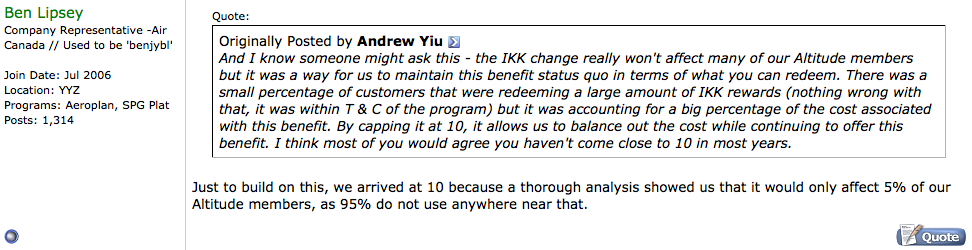
the company representative said that only 5% of altitude members will feel this change. well of course it only affects 5% of altitude members because the benefit wasn't available to 100% of altitude members to begin with. i wonder how many super elite members this will affect? probably more than just 5%.

also, the number of eupgrade nominees for super elite benefits will decrease to 1. this means that you can only upgrade one other person who is not actually traveling with you where as you could have done more in the past.

conclusion
my traveling plans are increasing this year, especially in my first year out of residency. i was debating between moving to either air canada or united as my primary frequent flyer program, and i think i might be heading more in the direction of united.
  • the majority of my transborder flights are on united now to avoid the air canada 50% AQM
  • air canada international tango fares still earn 100% on united
  • i will get access to premium economy on united
  • i might be able to access the unlimited domestic upgrades for united flight
  • as a non-american based elite, i would be exempt from the minimum spend requirements for united
i also wonder whether they will backtrack and soften the blow, but it sounds like they won't be doing this. 

Friday, 19 September 2014

westjet tweaks its program -- it's now a bit more competitive

westjet recently announced its latest improvements to its rewards program. i would definitely say its an improvement to its current program in that it rewards users for increased travel. it becomes a frequent flyer program rather than a rebate program.

until october 29. 2014, members earn 1% back in westjet dollars on the first $1,500 spent in a year, and then 2.5% back on everything after that. note that taxes and surcharges are not included.

after october 29, 2014, they are introducing new tiers:


the minimum earn remains the same, but on amounts after $1,500 a year, the earning rate increases from 2.5% to 3%. after $4,000 a year, it increases to 5%. again, taxes and surcharges are not included.

milestone awards
the milestone for getting a bonus $35 westjet dollar voucher remains the same -- it is awarded after $1,500 in spending. however, in the old program, one would get an additional $25 for every $1,500 spent after that. these are gone in the new program. at 5% of each dollar spent, each $1,500 increment would yield $37.50 above what one would have earned if they were to have just gotten 2.5% back under the old program. therefore, this new scheme, even without the milestone bonuses, is a good thing for consumers. and one does not need to actually hit the individual $1,500 thresholds to get the bonus (i.e., it's not all or nothing).

the companion flights remain the same. after spending just $4,000 a year, you can get a free companion flight anywhere westjet flies. this can potentially be quite a value. (in the old program, the first companion flight was awarded after $4,500 a year in spending).

flight benefits
in trying to copy most of the legacy airline frequent flyer programs, westjet introduces flight benefits. now that westjet has started to charge for its first bag, silver and gold status now have extra value. it's like what star gold (and previously, what star silver) does for the star alliance member carriers.

there's no way to get unlimited lounge access, even after having spent $6,000 a year on westjet flights. but you are able to get priority boarding and security at the highest level.

overall analysis
without a doubt, this is a better deal than what they used to offer. i also appreciate that unlike air canada's aeroplan or american airlines' aadvantage (where you could credit your westjet flights to), you get the equivalent of cash. you don't have to hunt for award space. you don't have to take flights at inconvenient times just to use your miles. you can use them whenever you want.

i like that they reward people who fly more with their airline. it shows the frequent flyer that the airline understands how important frequent and repeat flyers are. the little perks such as advanced boarding are helpful so that a frequent flyer will never be forced to gate check their carry-on luggage in an effort to avoid the check-in fee.

i like how all flights count towards "status" in an equal sense. lowest fares will earn lower westjet dollars, but it still counts in a real way when trying to achieve the next tier. unlike air canada, domestic tango fares (which are typically $65 + tax less than their flex fares) will only fetch you 25% of the status miles, and it is only by paying the flex fare will you get all the miles that you've actually flown. it just feels more fair.

i still think there is room for improvement. partner airlines don't count (unless it's a westjet flight number). the flight benefits are not applicable to partners. you're also limited to the few routes that westjet flies, and there is more to this world than canada.

but i don't want to focus on those small details. in reality, i think this is an excellent step that westjet has taken.